

Overhead vs Sidewall People Counting for Retail Entrances
Retail entrances are becoming more difficult to measure. Traditional doorways are increasingly replaced by wide open storefronts, large shopping mall entrances, multiple access points and architectural designs where there may be no convenient place to install a conventional overhead sensor.
This creates a practical question for retailers, shopping mall operators and system integrators: should a people counter be installed above the entrance or on a sidewall?
There is no universal answer. The right mounting method depends on entrance width, ceiling height, visitor flow, traffic intensity and the type of information the retailer wants to collect.
The SensMax TAC-B EWP is designed for both approaches. The same 60 GHz mmWave radar sensor can operate in sidewall or overhead mode, allowing the installation method to be selected according to the actual retail environment.
Why Retail Entrance Geometry Matters
A people counting system does not measure an abstract doorway. It measures people moving through a physical space.
A narrow store entrance with a standard ceiling creates a very different counting environment from a six-metre-wide shopping mall opening where customers can enter and leave along several trajectories at the same time.
Before choosing the installation method, it is useful to understand:
- entrance width;
- ceiling or available mounting height;
- whether a suitable wall, column or ceiling structure is available;
- how visitors normally move through the entrance;
- how intense traffic becomes during peak periods;
- whether IN/OUT counting alone is required or additional zones are needed;
- whether passers-by in front of the store should also be measured;
- whether anonymous adult/child classification is useful;
- whether the installation should use Ethernet and PoE infrastructure.
These factors determine whether overhead or sidewall radar provides the more practical installation.
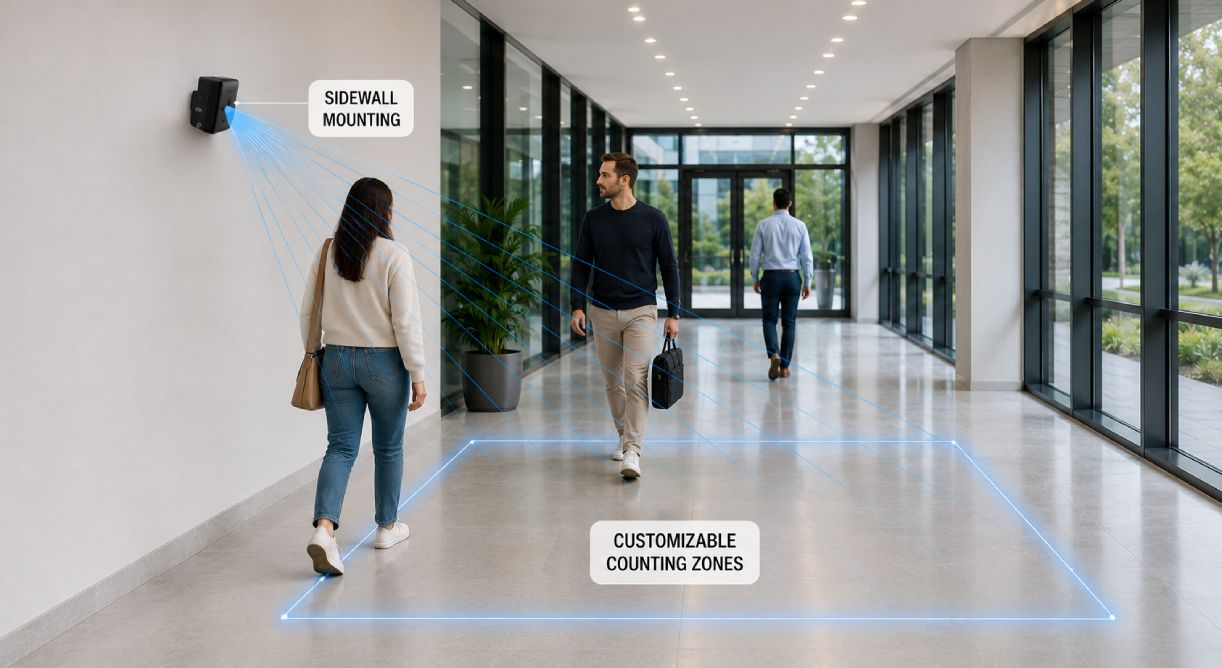
SensMax TAC-B EWP sensor mounted on a sidewall.
How Sidewall People Counting Works
In sidewall mode, the radar is mounted on a wall, column or another stable vertical structure and monitors movement across the entrance or passage.
Instead of looking straight down at one doorway, the sensor observes a wider area from the side. Virtual counting lines and zones are then configured according to the actual visitor flow.
TAC-B EWP sidewall mode provides a horizontal field of view of approximately 120° and a vertical field of view of approximately 60°, with a detection range of up to 10 metres. Up to five independent counting lines or zones can be configured.
When Sidewall Mounting Works Well in Retail
Sidewall installation is particularly useful for:
- wide retail entrances;
- open-front stores in shopping malls;
- entrances where the ceiling is too high for practical overhead installation;
- locations where ceiling installation is restricted;
- corridors and passages with several possible walking trajectories;
- areas where several counting lines or zones are required;
- retail environments with intense visitor traffic;
- locations where passers-by and actual store entries need to be analysed separately.
For sidewall installations, TAC-B EWP is typically mounted at approximately 2.5 to 3.5 metres above floor level. Correct height, angle and sensor position remain important because the radar needs a clear view of the monitored area.
The Main Advantage: Installation Flexibility
One of the biggest advantages of sidewall counting is that the sensor does not need to be installed directly above the entrance.
This matters in modern shopping centres, where storefronts can have decorative ceilings, lighting structures, suspended signage, very high ceilings or completely open entrances.
A wall or structural column can often provide a much simpler mounting point.
Counting Passers-By as Well as Store Entrances
For some retail locations, the most useful question is not only how many people entered the store, but how many people passed in front of it.
This is especially relevant for stores inside shopping malls, high streets, outlet centres and other locations where the storefront receives substantial pedestrian traffic.
In sidewall mode, radar can monitor a wider area and use separate virtual counting lines or zones. Where the store geometry allows it, one line can be configured to measure pedestrian traffic passing the storefront while another measures actual store entries.
This creates an additional retail KPI: the relationship between passing traffic and store entries.
A store may have strong footfall in front of the entrance but relatively few people entering. Another store may attract a much larger share of passing visitors inside. Comparing these two numbers can help retailers evaluate entrance visibility, window displays, promotions and storefront performance.
The same approach is relevant for street-facing shops and outdoor retail entrances. Because radar does not depend on visible light, it can be used in environments where daylight, shadows and changing visual conditions would complicate optical detection.
TAC-B EWP is designed for both indoor and outdoor installation, making the same radar platform suitable for entrances inside shopping malls as well as exposed retail access points.
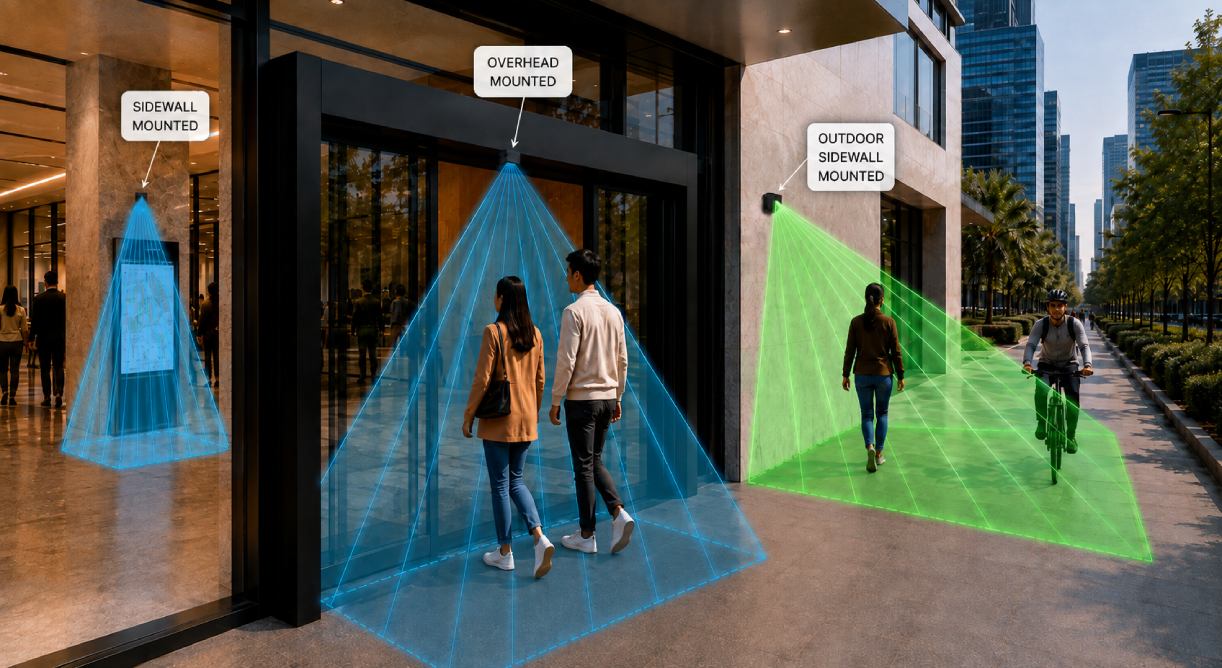
SensMax TAC-B EWP sensor counting visitors passing by an outdoor retail storefront.
How Overhead People Counting Works
In overhead mode, TAC-B EWP is installed above the monitored area and points downward toward the floor.
This creates a different radar geometry. Visitors are detected as they move beneath the sensor, making overhead mode suitable for entrances where a suitable ceiling or overhead mounting structure is available.
The overhead radar field of view is approximately 106°. The monitored floor area expands as installation height increases. At around 2 metres height, the coverage diameter can reach approximately 3.5 metres. At approximately 3.5 metres height, suitable installation geometry can provide floor coverage up to approximately 7.5 metres.
When Overhead Mounting Works Well in Retail
Overhead installation can be a strong choice for:
- defined retail entrances;
- shopping mall access points with a suitable ceiling;
- department store entrances;
- corridors and controlled passage areas;
- locations where the retailer wants the sensor positioned directly above the visitor flow;
- projects where anonymous adult/child classification is useful.
Overhead installation is typically used from approximately 2 metres upward, with the required height determined by entrance width and project geometry. For installations above approximately 3.5 metres, or locations without a suitable overhead mounting point, sidewall mode is normally the more practical option.
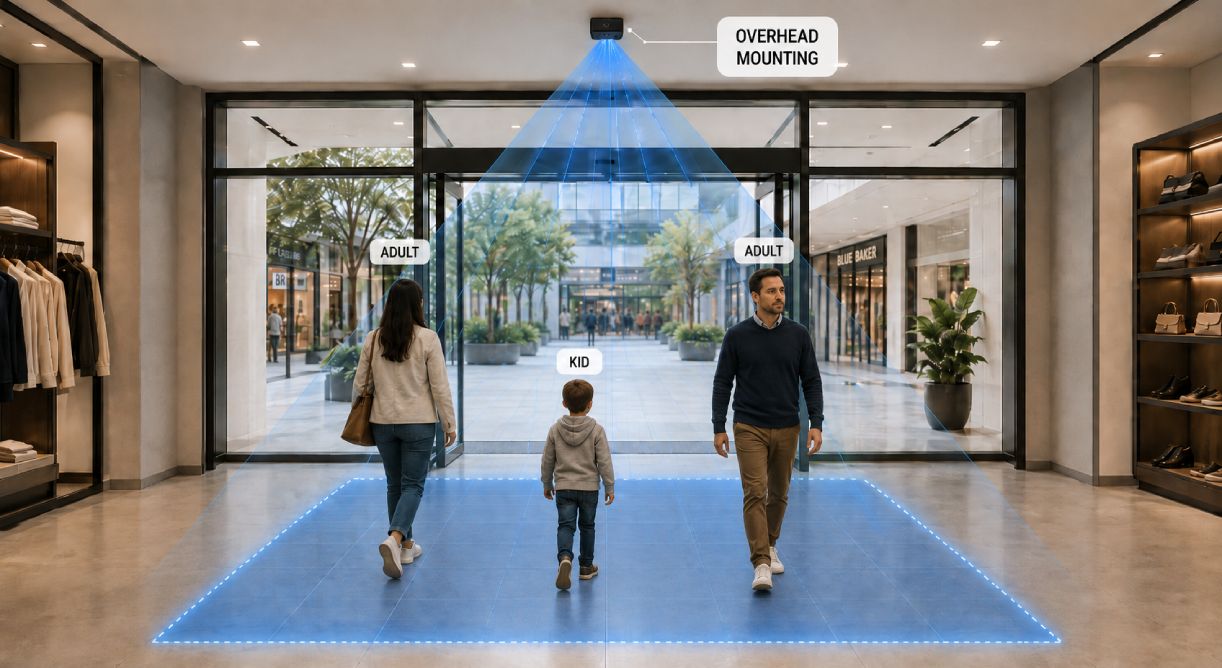
SensMax TAC-B EWP sensor for overhead people counting.
What Overhead Mode Adds: Adult and Child Classification
One additional capability of overhead mode is anonymous adult/child classification based on detected object height.
This can provide useful context in family-oriented shopping centres, entertainment venues and other retail environments where understanding the proportion of adult and child visitors has operational or commercial value.
The classification is performed without taking photographs, recording video or identifying individual visitors.
Sidewall vs Overhead People Counting: Quick Comparison
| Factor | Sidewall Mode | Overhead Mode |
|---|---|---|
| Typical installation | Wall, column or side structure | Above the monitored area |
| Typical retail use | Wide entrances, open storefronts, high ceilings | Defined entrances with suitable overhead mounting |
| Installation height | Approx. 2.5–3.5 m | Approx. 2–3.5 m depending on entrance width |
| Field of view | Approx. 120° horizontal × 60° vertical | Approx. 106° |
| Coverage | Up to approx. 10 m detection range | Up to approx. 7.5 m floor diameter at 3.5 m mounting height |
| Counting logic | Up to 5 lines/zones, bidirectional IN/OUT | Up to 5 lines/zones, bidirectional IN/OUT |
| Passers-by analysis | Possible where geometry allows separate counting lines or zones | Usually focused on the defined area directly below the sensor |
| Additional classification | No | Anonymous adult/child classification by height |
| Indoor / outdoor | Both | Both, depending on mounting structure |
| Camera required | No | No |
What About Wide Shopping Mall Entrances?
Wide entrances are one of the most common reasons to consider radar instead of traditional break-beam people counters.
With a conventional infrared counter, visitors normally cross a clearly defined beam between two sensor units. This works very well for standard entrances but becomes less practical when people can move through a large open area using several trajectories.
Radar uses a different approach. Instead of defining the entrance with a physical infrared beam, the installer defines virtual counting lines and zones inside the radar detection area.
For an open retail entrance, these lines can be positioned according to the actual geometry of the store. Up to five independent lines or zones can be configured with TAC-B EWP.
This makes radar particularly useful for:
- shopping mall stores with open facades;
- department stores;
- supermarkets and hypermarkets;
- large fashion stores;
- shopping centre entrances;
- food courts and shared retail areas.
Why PoE Matters in Shopping Malls
Sensor performance is only one part of a large retail deployment. Installation and network infrastructure also matter.
TAC-B EWP supports Power over Ethernet, allowing power and Ethernet communication to use the same network cable.
For professional retail and shopping mall projects, this can simplify:
- power distribution;
- network installation;
- central infrastructure management;
- deployment of multiple sensors across one site;
- integration with existing IT and building networks.
The sensor also supports Wi-Fi, MQTT and API integration, allowing counting data to be connected to SensMax reporting or external retail, business intelligence and building management systems.
From People Counting to Real-Time Retail Operations
For shopping malls and larger stores, the value of radar extends beyond the daily visitor total.
Realtime IN/OUT data can be used to calculate occupancy and understand how visitor volumes change throughout the day.
Retailers and shopping mall operators can use these insights for:
- peak-time staffing;
- store and mall occupancy monitoring;
- comparison of different entrances;
- conversion analysis by combining footfall with transaction data;
- evaluating storefront performance using passers-by versus store entries;
- cleaning and facility planning;
- comparison of visitor trends between locations and periods.
For more advanced projects, TAC-B EWP also supports integration through MQTT and API, while its built-in relay can be used as an input for external automation scenarios.
Overhead or Sidewall: Which Should You Choose?
The decision should start with the physical entrance rather than with a preference for one mounting method.
Consider Sidewall Mounting When:
- the entrance is wide or completely open;
- there is no suitable ceiling directly above the entrance;
- the ceiling is higher than the practical overhead installation range;
- installation on a wall or column is easier;
- you need to monitor a wider area rather than only the point directly below the sensor;
- several virtual counting lines or zones need to be positioned across the monitored area;
- you want to analyse passing traffic in front of the store as well as actual entries.
Consider Overhead Mounting When:
- there is a suitable ceiling or mounting structure above the entrance;
- the visitor flow passes through a clearly defined area below the sensor;
- the entrance width fits within the required overhead coverage;
- adult/child classification is relevant to the project;
- a top-down installation fits better with the architecture of the entrance.
Accuracy Depends on Installation, Not Only Technology
No mounting method is automatically more accurate in every retail environment.
The quality of the result depends on choosing the correct mode for the entrance geometry and then configuring the sensor properly.
Important factors include:
- mounting height;
- sensor angle;
- entrance width;
- visitor density;
- direction of movement;
- position of counting lines;
- objects or structures inside the detection area.
Under suitable installation conditions, TAC-B EWP can achieve counting accuracy above 99% at a visitor density of approximately one person per square metre.
For this reason, entrance photos, dimensions and an understanding of expected traffic are useful before selecting the final mounting position.
One Sensor, Two Installation Strategies
Retail environments are not standardized. A boutique entrance, an open shopping mall storefront and the main entrance of a shopping centre can each require a different approach.
The advantage of TAC-B EWP is that retailers and integrators do not have to choose a completely different sensor platform simply because one location requires overhead mounting and another requires sidewall installation.
The same PoE-powered 60 GHz mmWave radar platform can be configured for either mode and integrated into the same reporting infrastructure.
Sidewall mode also extends the possible measurement area beyond the doorway itself. Where the geometry supports it, retailers can measure pedestrian traffic in front of the store and compare it with actual entries, creating another useful layer of retail footfall analytics.
Start With the Entrance, Then Choose the Mounting Mode
The most important question is therefore not “Is overhead or sidewall better?”
It is: Which installation geometry gives the sensor the clearest and most useful view of the actual visitor flow?
For a defined entrance with a suitable ceiling, overhead installation can provide a clean top-down counting area and anonymous adult/child classification.
For wide entrances, open retail facades, high ceilings, street-facing stores or locations where overhead installation is difficult, sidewall mounting provides greater flexibility and can also make it possible to analyse pedestrian traffic passing in front of the store.
With both modes available in SensMax TAC-B EWP, the mounting method can be selected around the retail environment instead of forcing the entrance to fit the sensor.
Planning a retail or shopping mall people counting project? Send SensMax the entrance width, mounting height, photos and expected traffic intensity. We can help determine whether sidewall or overhead radar counting is the better fit.
