
Privacy-safe people counting
People counting has become a crucial part of operating businesses and managing public spaces as it helps understand foot traffic patterns. The techniques and technologies used have advanced significantly over the years, from the days of manual clickers to the current highly accurate systems.
But, as with other technologies, privacy has become a key concern in people counting. Privacy regulations like the GDPR in the EU and California’s CCPA also pose significant technical challenges for businesses worldwide.
This has created a strong need for privacy-safe people counting, and radar people counters are quickly becoming the go-to option. We’ll look at the reasons behind this in detail.
The privacy concerns of traditional people counting
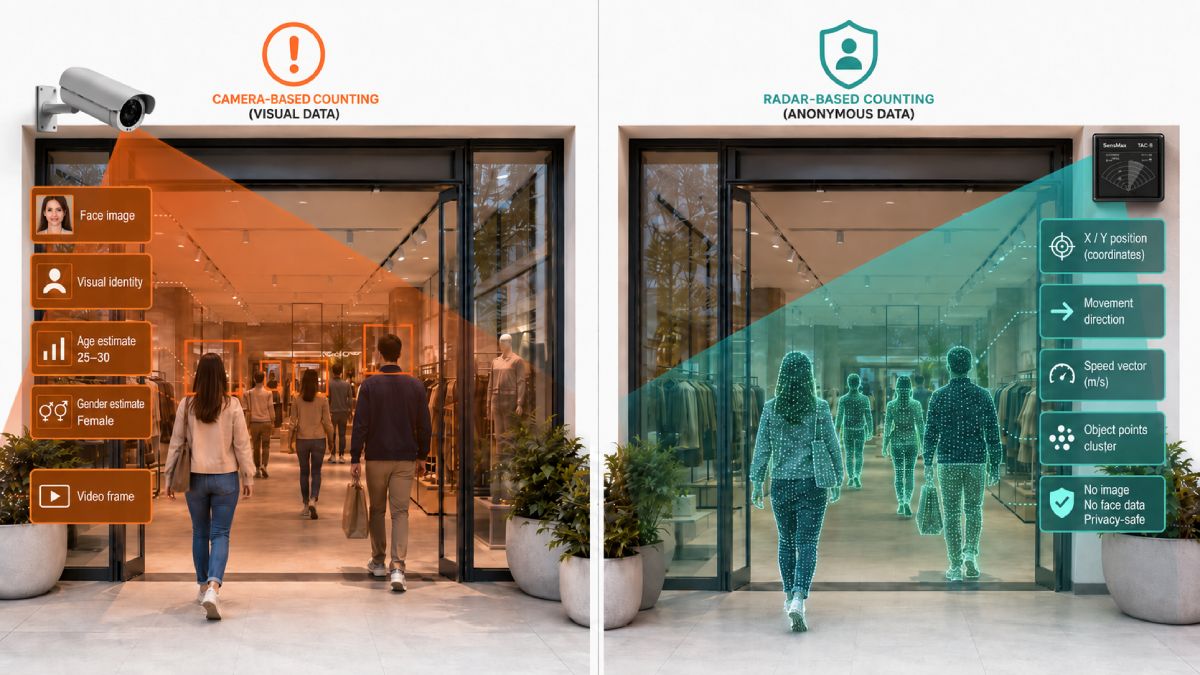
Most traditional people counting systems rely on video cameras or device tracking. Cameras are accurate and can distinguish between people going in and coming out, and they can even tell staff from customers by recognizing the uniform.
However, they capture images of individuals. Even if you anonymize the images during processing, you’ve still captured data that can identify people. Some people will be uncomfortable while shopping, and it also subjects you to privacy regulations.
Device-based tracking through Wi-Fi or Bluetooth signals is an alternative as it helps avoid cameras, but it still collects personal device data. It’s also not accurate.
This means using both systems comes with lots of operational overhead. You need to spend time and lots of resources to deal with compliance, signage, and data governance instead of just focusing on insights.
How radar-based people counting works in practice
Radar people counters may rely on sophisticated engineering, but the principle behind them is quite simple. The sensor emits low-power radio waves, often in the mmWave band, and analyzes how those waves reflect off moving objects.
The technology can differentiate between people moving in and moving out. It can also determine the depth by analyzing the returned signal, so it’s reliable in crowded spaces.
Due to its basis on signal reflection rather than vision, radar works reliably in conditions where technologies like video cameras struggle. They also cover a larger area. Sensors like the SensMax TAC-B range can have up to 5 user-defined independent lines and zones reaching up to 10 metres with a 120° viewing angle. That’s 100 m² in total surface.
Why radar fits privacy-first deployments
Radar people counting offers lots of privacy-related benefits.
Anonymous by design, not by policy
You can achieve privacy by policy or by design. When using camera-based systems, privacy often depends on how the software is configured, how you process data, and how long you store images or videos.
Radar systems don’t create real-person images, don’t track devices, and don’t generate any biometric markers. The system only works with motion and depth to determine how space is occupied, so there’s no personal data to secure or even explain away later.
Lower compliance and governance overhead
Privacy-safe people counting goes beyond the data you collect to the documentation, signage, and data protection reviews. But since radar sensors don’t collect any personal data, you don’t have to worry about data retention policies, anonymization, or securing image archives.
This reduces the risk from a breach and the huge fines that come with it, which, for many organizations, is just as valuable as the counting itself.
A better fit for sensitive and shared spaces
Some environments come with an extra layer of expectation around privacy. Even when cameras are technically allowed, they can change how people feel about that space.
Radar sensors help avoid raising privacy concerns because they don’t record anyone. They don’t even look like cameras, so most people never notice them. And in case of any questions, you’ll have a simple explanation that they count movement, not actual people.
Scales cleanly across buildings and sites
Privacy challenges tend to multiply as a business grows. While you can easily justify one camera at the entrance, things are a bit more complicated when you want to deploy dozens across a large store or building. Even if the motive is just to get an idea of which aisles people tend to spend most time in, it won’t appear so to customers.
Radar people-counting systems scale much more cleanly since there’s no additional privacy risk. This makes the technology the best way to monitor real-time occupancy and customer behavior.
Aligns with long-term privacy expectations
Privacy regulations and expectations are always evolving. What feels acceptable today might feel intrusive or even outright illegal a few years from now. Radar is a safer long-term bet as it aligns with the shift towards data minimization. It also reduces the risk of costly system replacements in the future.
Where radar people counting delivers the most value
One of the biggest strengths of radar people counters is that they can be deployed across a wide variety of spaces.
Retail, malls, and commercial buildings
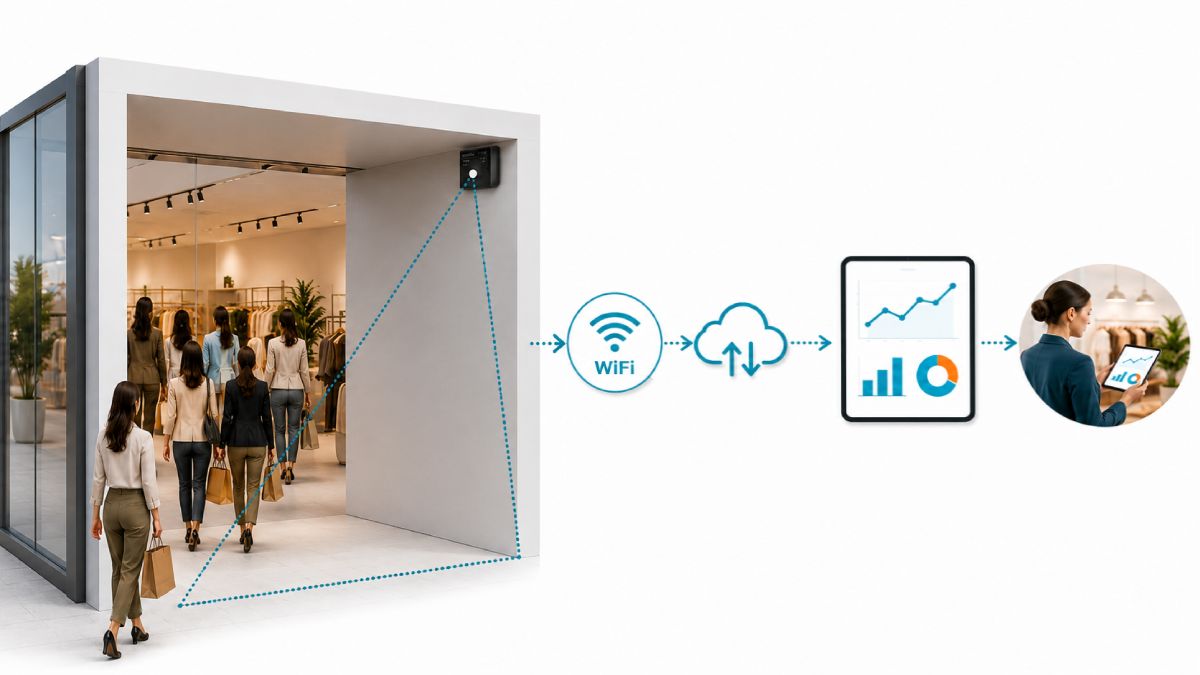
Indoor units like the SensMax TAC-B 3D-W can be deployed in entrances and within stores and buildings. They can know how many people enter a store, how traffic flows between sections, and when peak times hit. The sensor transmits information in real time via Wi-Fi, so it can help open an extra counter just before queues start forming
Public spaces, parks, and trails
Traditional people counting tools struggle outdoors as lighting changes constantly and weather poses a significant challenge. Radar people counters handle this challenge without complications.
A unit like the SensMax TAC-B 4G Outdoor or the SensMax TAC-B 3D-WP can count pedestrians and cyclists in real time, day or night, in rain or direct sun. These send data wirelessly, and you can even add a solar setup like the SensMax SPS20 in off-grid deployments.
Offices, coworking spaces, and shared workplaces
In these kinds of spaces, radar people counters can help determine how space is being utilized. They can track the number of people in meeting rooms, common areas, or even entire floors. This can help understand the spaces that are consistently underused or optimize cleaning schedules.
Public washrooms and other sensitive areas
When managing public washrooms, you need to optimise cleaning schedules, manage queues, and essentially know how many people use the facilities and how often.
You can’t install cameras here, but radar sensors will give you all the information you need without breaking any law or raising privacy concerns.
Transit hubs and public buildings
Airports, train stations, libraries, and museums all deal with fluctuating numbers of people and complex traffic patterns. Radar people counters can help these spaces monitor patterns and make decisions by feeding managers data in real time. You can monitor congestion and take actions like redirecting foot traffic or adjusting cleaning and maintenance schedules.
Radar as the new standard for people counting
While people counters have been around for a long time, the conversation is now shifting towards measuring foot traffic and ocupancy ina way that holds up operationally, legally, and socially.
Radar people counters check all three as they don’t collect any personal data. They are GDPR-compliant out of the box. They also don’t affect customer behavior and are much easier and cheaper to install compared to video cameras.
This combination is steadily tilting business preferences and making radar systems the new standard for people counting.
