

Why Retailers Are Moving Beyond CCTV Systems
Most retail chains already use CCTV for security, incident review and loss prevention. However, using the same system for retail people counting often leads to unreliable results, operational complexity and privacy concerns.
In 2026, retailers are shifting toward dedicated people counting sensors such as SensMax TAC-B radar sensors combined with SensWeb reporting software. These solutions provide accurate, real-time, and standardized footfall data designed for business decision-making rather than video interpretation.
The Core Problem: CCTV Produces Raw Data, Not Business Metrics
CCTV systems are built for reviewing events, not measuring store performance. When used for footfall analytics, they generate inconsistent data that requires additional processing and interpretation.
- Accuracy issues in real store conditions
- Privacy risks due to image capture
- High complexity when scaling across multiple locations
Dedicated people counting sensors eliminate these issues by producing clean, standardized counting events that can be used directly in operational reports.
1) Accuracy: CCTV Struggles in Real Retail Environments
Lighting and reflections distort results
Sunlight, shadows, glass reflections and changing lighting conditions reduce CCTV counting accuracy, especially at store entrances.
Occlusions break counting logic
Groups, families and high traffic overlap create miscounts when cameras try to interpret crowded scenes.
Inconsistent installation across stores
Different camera angles and heights make chain-wide benchmarking unreliable.
Radar-based sensors such as SensMax TAC-B operate independently of lighting and visual conditions, delivering consistent results across all locations.
2) Privacy: Cameras Capture Identity, Sensors Do Not
Even when used for counting, CCTV systems still capture identifiable video data, creating compliance and perception challenges.
- Image capture requires governance and policies
- Customer and employee concerns increase
- Compliance requirements become more complex
Radar people counting works without cameras, producing anonymous counting data without capturing personal information.
3) Complexity: CCTV Analytics Is Difficult to Scale
Deploying CCTV-based analytics across multiple stores typically requires:
- High processing power
- Network bandwidth
- Continuous tuning
- Complex integrations
In contrast, people counting sensors provide ready-to-use data with minimal infrastructure and faster rollout.
What Retailers Actually Need from People Counting
Retail operations require clear, standardized metrics rather than raw video data:
- Visitor trends by hour, day and season
- Accurate IN/OUT counts and occupancy
- Store-to-store benchmarking
- Conversion rate calculation (visitors vs sales)
- Real-time operational triggers
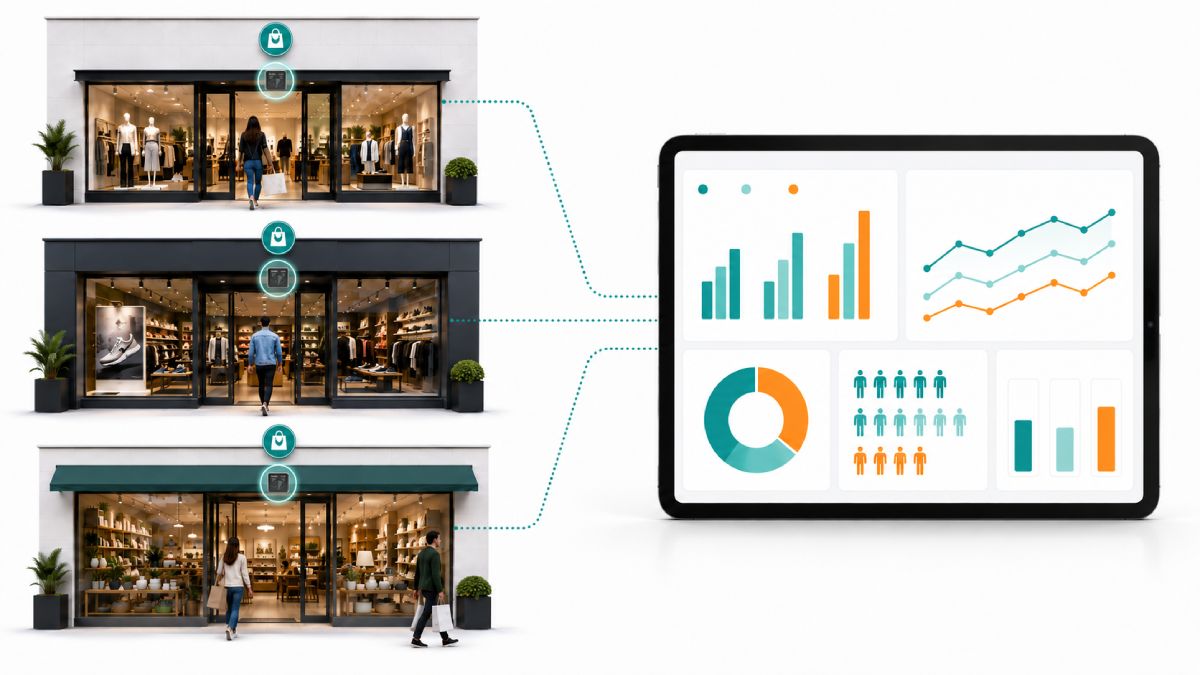
SensWeb: From Sensor Data to Business Decisions
The SensWeb platform converts raw counting events into business-ready dashboards, reports and KPIs.
This allows retailers to align staffing, monitor performance and optimize operations using consistent and comparable data.
Modern Approach: Hybrid Model
Retailers are not replacing CCTV entirely. Instead, they are separating roles:
- CCTV for security and incident review
- People counting sensors for analytics and operations
This approach ensures both systems operate efficiently without overlap or compromise.
How Retailers Deploy People Counting Systems
- Start with main entrances
- Define KPIs: traffic, occupancy, conversion
- Integrate with POS data
- Establish reporting routines
- Expand coverage after baseline stabilization
This structured rollout ensures that retail people counting becomes a core management tool rather than unused data.
Conclusion
In 2026, retailers are no longer trying to extend CCTV into analytics. Instead, they are adopting dedicated people counting systems that provide accurate, privacy-safe and scalable data.
Solutions such as SensMax TAC-B radar sensors combined with SensWeb deliver clear operational insights, enabling better decisions, improved performance and higher conversion rates.
