

What “People Counter Accuracy” Actually Means (In Retail Terms)
Most teams ask, “What’s the accuracy percentage?”
The better question is: Can I trust the data enough to run the store with it?
In practice, people counter accuracy is the gap between:
- the true baseline (what really happened at the entrance), and
- the system count (what your sensors recorded).
A reliable sensor accuracy comparison is not a one-time install check. It’s a discipline:
- Baseline audit (validate counts against a true reference in the same time window)
- Standardized benchmarking (consistent time windows and sampling rules so results are comparable)
- Variance monitoring (watching drift over time so issues are detected early, not after dashboards go wrong)
This is the difference between “marketing accuracy” and operational accuracy you can run payroll and performance reviews on.
Why Accuracy Gets Lost in the Real World
Retail entrances are messy. A sensor that performs well in one environment can degrade in another. The most common accuracy killers are:
- Side-by-side traffic (families, groups, peak-time surges)
- Wide entrances (more paths, higher overlap, more edge cases)
- Occlusions (carts, strollers, displays, people blocking people)
- Environmental noise (glare, shadows, changing light, reflections)
- Mismatch between tech and use-case (the sensor wasn’t chosen for your entrance conditions)
This is why people counter accuracy depends on technology + environment, not brochure numbers. And it’s why sensor accuracy comparison should focus on how errors occur, not just how often.
The Two-Track Strategy Retailers Use in 2026
Retailers don’t all need the same solution. Most chains get the best outcomes by choosing between two clear paths:
Track 1: The “Efficiency Track” - IR Sensors for 80% of Retail Use Cases
For the majority of retail entrances, the best choice isn’t the most complex system; it’s the most cost-effective and reliable system.
IR sensors (like SensMax D3) are ideal when retailers want:
- dependable entrance counting
- strong ROI
- low operational overhead
- a lower total cost of ownership (TCO) than complex video-based setups
This is why IR remains the practical standard for 80% of retailers: it delivers consistent data for daily decisions, without forcing the organization to run heavy processing pipelines or manage complex deployments.
In other words: for many chains, IR is the fastest way to achieve people counter accuracy that’s good enough to operationalize; staffing, conversion, and performance tracking without paying a premium complexity tax.

Where IR Delivers The Best Value
IR-based counting performs best when:
- entrances are well-defined
- traffic paths are predictable
- the primary need is reliable in/out counts that feed consistent reporting
If your goal is to scale a dependable baseline across a chain, the “Efficiency Track” is often the right first move in any sensor accuracy comparison.
Track 2: The “High-Tech Track” - mmWave Radar as the Premium Choice
Some entrances are simply harder:
- wide openings
- heavy group traffic
- carts/strollers
- frequent occlusion
- demanding accuracy expectations for high-stakes reporting
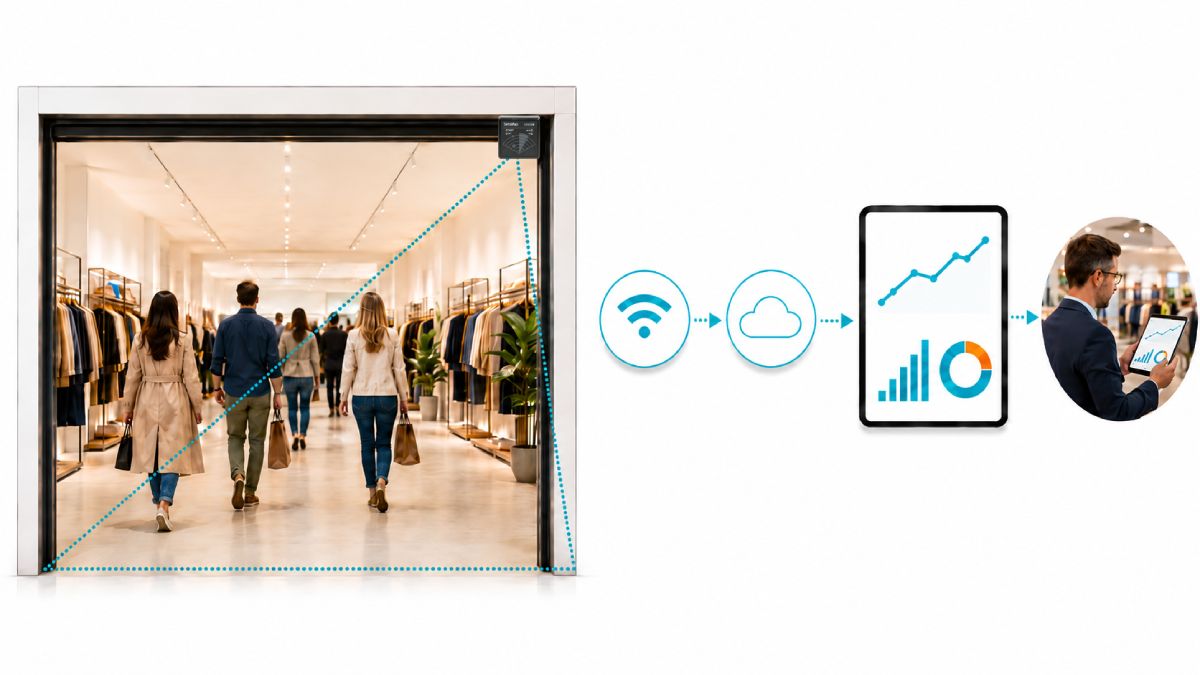
This is where mmWave Radar (SensMax TAC-B) becomes the premium option.
Why Radar Wins In 2026
Radar strengthens people counter accuracy while avoiding two big traps retailers are moving away from:
- Privacy risk
Radar supports counting without capturing identity. That means high accuracy without the privacy baggage that comes with camera-based approaches. - Environmental fragility
Camera and thermal approaches are often sensitive to lighting and environmental conditions. Radar is built for counting signals, not image interpretation; so it’s a strong fit when conditions are inconsistent and entrances are complex.
For retailers that need premium performance and privacy-first deployment, radar becomes the cleanest “High-Tech Track” in a modern sensor accuracy comparison.
Why Many Retailers Are Moving Away From Camera-Based Counting for Operations
Security cameras are built for security, not operational analytics.
When retailers try to use cameras for footfall metrics, they often inherit three problems:
1) “Raw Data” Problems
Video analytics frequently produces raw, interpretation-heavy outputs that vary by:
- lighting and shadows
- camera angle and placement
- occlusion and crowd density
That makes chain-wide comparability difficult.
2) Privacy and Governance Overhead
Even when the intention is “just counting,” cameras are identity-capable systems. That creates compliance workload, stakeholder concern, and governance overhead that many retailers want to minimize.
3) Complexity at Scale
Processing video across many stores is resource-heavy (infrastructure, tuning, maintenance). In contrast, dedicated sensors are built to produce cleaner counting events that are easier to standardize.
In 2026, operational teams want Business Answers, not fragile pipelines that turn footage into inconsistent metrics.
From Accuracy to Reliable Business Decisions: What SensMax Delivers
Accuracy matters because it feeds SensMax, and SensMax is where footfall becomes executive-grade reporting.
Instead of obsessing over “perfect percentages,” directors care about repeatable answers:
- Traffic by hour/day/week (peaks, dips, seasonality)
- Conversion denominator (transactions ÷ visitors)
- Staffing alignment (coverage matched to demand)
- Marketing impact (campaign lift vs baseline)
- Occupancy trends (real-time signals + historical context)
This is the business reason people counter accuracy matters: inaccurate inputs don’t just create “bad data”, they create bad decisions.
How to Evaluate People Counter Accuracy in the Real World
Use this as a retail-ready sensor accuracy comparison checklist:
1. Start with entrance reality
- entrance width, traffic density, group behavior, carts, occlusions
2. Run a baseline audit
- compare sensor counts against a true reference in the same time window
3. Standardize benchmarks
- keep audit windows and sampling rules consistent so tests are comparable
4. Monitor variance (ongoing QA)
- detect drift early, before it shows up as staffing or conversion problems
5. Choose the right track
- IR (D3) for cost-effective scale in standard conditions
- mmWave radar (TAC-B) for premium accuracy + privacy-first needs in complex environments
That’s how you turn people counter accuracy from a “setup claim” into a measurable operational standard.
In 2026, retailers don’t win by collecting more counts. They win by collecting reliable counts that translate into reliable Business Answers.
- IR sensors (SensMax D3) are the cost-effective, low-TCO solution for the majority of retailers that want dependable data at scale.
- mmWave Radar (SensMax TAC-B) is the premium choice for complex entrances, delivering high accuracy without the privacy risks and environmental fragility of camera or thermal approaches.
- SensMax turns those inputs into reporting leadership can act on- staffing, conversion, marketing impact, and occupancy decisions that don’t collapse under data noise.
