Museum & Art Gallery Climate Monitoring


Temperature and Humidity Monitoring for Museums and Art Galleries
Valuable paintings, sculptures, historical objects and archival materials are highly sensitive to climate conditions. The SensMax SensGuard museum temperature and humidity monitoring system helps museums, galleries and archives maintain stable environmental conditions in exhibition halls, storage rooms and display cases. The solution is designed for artwork preservation, archive climate control and long-term conservation monitoring.
What the museum temperature and humidity monitoring system does
SensGuard provides continuous temperature and humidity monitoring for museums and art galleries. Wireless sensors measure the microclimate near artworks, inside display cases and in storage areas and send readings to the cloud every 5 minutes. The system compares measured values with individually defined limits for each location and alerts responsible staff if conditions drift outside the safe range.
By reacting early to deviations, conservators and facility teams can prevent mold growth, paint layer cracking, wood warping, metal corrosion and deformation of paper or textile objects. The system creates a detailed climate history used for conservation analysis, reporting and inspections.
Why climate monitoring is critical for museums and galleries
Museum climate monitoring is essential because even small long-term deviations in temperature or humidity can permanently damage artworks and archival materials. Stable environmental conditions support preservation planning, insurance compliance and exhibition safety.
- Protects paintings, paper, textiles and wooden objects from humidity damage
- Supports conservation standards and audit requirements
- Provides documented environmental history for collections
- Helps detect HVAC or ventilation problems early
- Enables preventive conservation instead of reactive repair
Use cases for museum and gallery climate monitoring
- Exhibition halls — climate monitoring around paintings and sculptures
- Museum storage and archives — temperature and humidity control for collections
- Glass display cases — microclimate monitoring near sensitive objects
- Entrance and transition zones — monitoring areas exposed to outdoor air
- Historic interiors — preservation of furniture and heritage materials

Wireless museum climate monitoring sensors are installed discreetly near artworks.
How the SensGuard museum climate monitoring system works
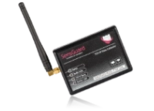
The museum climate monitoring system uses compact wireless sensors placed close to artworks or in representative room locations. Sensors record temperature and relative humidity every 5 minutes and send data to the SensMax TCP LR X2 gateway, which transmits it to the SensGuard cloud platform.
Each sensor has configurable allowed temperature and humidity ranges and permitted violation time. Short fluctuations can be ignored while long deviations trigger alerts. When limits are exceeded beyond the allowed period, notifications are sent via e-mail and Telegram messenger.
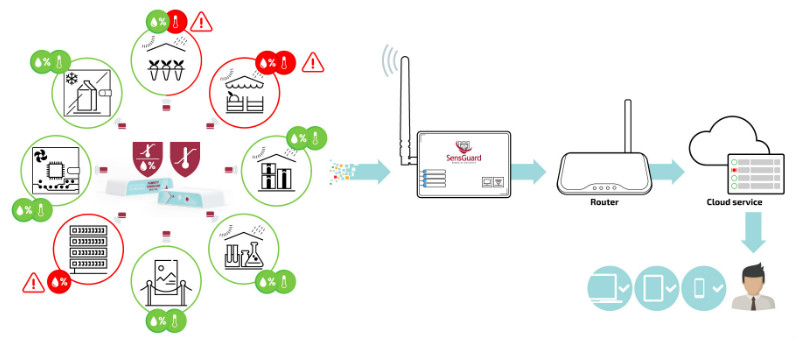
SensGuard architecture for museum temperature and humidity monitoring.
Wireless sensors operate from nonflammable internal batteries with a typical lifetime of up to 5 years. One gateway can collect data from up to 250 sensors within 150 m (extendable to 500 m with repeaters). Gateway buffer memory prevents data loss during temporary Internet outages.
Request museum climate monitoring consultation
Hardware used in this museum climate monitoring solution
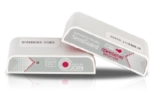
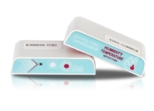
SensMax provides several wireless temperature and humidity sensors for museum environmental monitoring. Compact housings allow unobtrusive installation near artworks without cabling.
| Device | Type | Temperature range | Accuracy | Resolution | Battery | Typical use |
|---|---|---|---|---|---|---|
| MCP9800 wireless temperature sensor | Waterproof sensor | −20…+55°C | ±0.5°C | 0.1°C | up to 5 years | Museum room temperature monitoring in halls and storage areas. |
| ENS210 wireless temperature & humidity sensor | Temp & RH sensor | −20…+55°C / 0–100% RH | ±0.5°C / ±3.5% RH | 0.1°C | up to 5 years | Museum humidity monitoring near artworks and archives. |
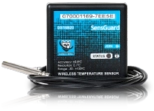
| DS18B20 probe wireless sensor | Probe sensor | −30…+120°C | ±0.5°C | 0.1°C | up to 5 years | Display case and enclosed space climate monitoring. |
Climate reporting for museums and conservation documentation
All readings, alarms and user notes are stored in a central database. This provides a complete environmental history for each room or display case. Data can be exported as CSV or PDF for conservation reports, insurance documentation and audits.
SensGuard cloud software for museums and galleries
- Live temperature and humidity dashboard per sensor
- Historical climate trend charts
- Individual thresholds per location
- Museum floor map sensor placement
- Role-based alert schedules
FAQ — Museum temperature and humidity monitoring
- Why is humidity monitoring important in museums?
Humidity changes can cause mold, corrosion and material deformation. Continuous monitoring helps prevent damage. - How often should museum climate be measured?
Best practice is continuous monitoring with frequent measurements such as every 5 minutes. - Can sensors be placed inside display cases?
Yes, compact wireless sensors and probe sensors support display case monitoring. - Is the system suitable for archives?
Yes, it is designed for museum archives and storage climate control. - Does monitoring require cameras?
No. Sensors measure only temperature and humidity and do not capture images.
Request a quote for museum monitoring system