


How to Count Pedestrians Outdoors: Practical Sensor Guide

Choose the right outdoor people counter for hiking trails, parks, and city streets based on path width, power availability, and anonymous radar or infrared sensing.
Municipal planners, park rangers, and facility managers often need reliable pedestrian counts outdoors, whether on a remote forest hiking trail or a busy downtown promenade. Outdoor sites create practical hurdles that indoor counters never face: no grid power, no local Wi-Fi, shifting sunlight and deep shadows, rain, and strict rules against video recording.
Selecting the right outdoor counting method comes down to two site factors: how wide the walking path is and whether power or cellular coverage is available. Matching the sensor to those real-world conditions prevents data gaps and avoids unnecessary trenching or cabling work.
Match the Sensor to Path Width and Site Conditions
Outdoor locations fall into two clear categories based on geometry and footfall behavior:
- Narrow paths and controlled choke points: Trailheads, wooden footbridges, park gates, and forest walkways where people pass single file or in pairs.
- Wide open spaces and shared corridors: City sidewalks, commercial promenades, public squares, and multi-use paths where crowds walk side by side alongside cyclists.
Horizontal infrared beam counters work reliably across narrow passages up to a few meters wide. When people walk across wide streetscapes or open plazas in groups, however, a single beam cannot separate individuals walking side by side. Those wide zones call for spatial 60 GHz mmWave radar that tracks every moving person across a broad detection area.
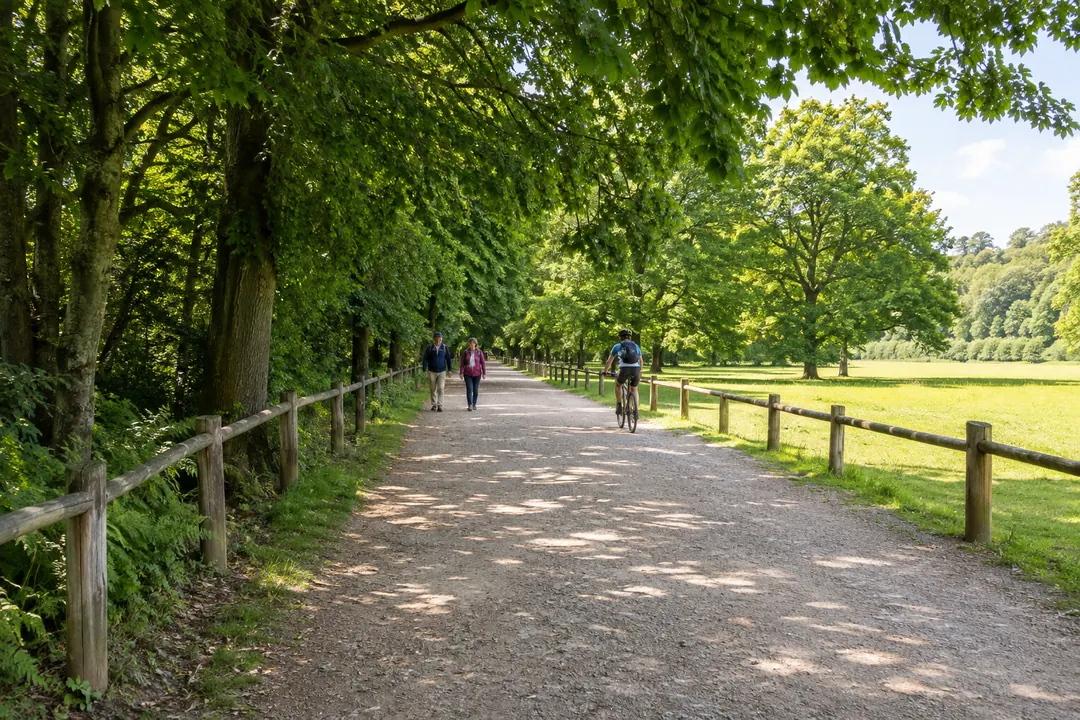
Off-Grid Trails and Parks: Battery Infrared Counters
For national parks, nature reserves, hiking trails, and seasonal recreation sites with no electricity or internet connection, wireless infrared counters provide a straightforward setup. The SensMax SE outdoor people counting sensor records total beam crossings for general trail volume, while the SensMax DE bidirectional outdoor sensor separates IN and OUT traffic so managers know both entry numbers and directional flow.
Both models are built specifically for unattended field operation:
- Zero cabling required: Sensors run on batteries for up to 2 years on the SE model and up to 1 year on the bidirectional DE model.
- Extended internal memory: Hourly traffic statistics stay stored inside the sensor for up to 250 days (SE) or 150 days (DE), ready for periodic collection with a handheld data collector.
- Outdoor durability: Waterproof, vandal-resistant enclosures mount cleanly on wooden trail posts, metal gates, bridge railings, or trees.
- Simple reporting: Collected data imports into SensMax reporting software to compare seasonal trends, weekend peaks, and maintenance schedules across every trailhead.
Busy Streets, Plazas, and Shared Paths: 60 GHz mmWave Radar
When counting pedestrians on wide sidewalks, municipal streets, transit plazas, or shared walking and cycling paths, 60 GHz mmWave radar handles wide-area traffic without capturing video images. Because radar relies on radio waves rather than optical lenses, sunlight glare, tree shadows, rain, fog, and complete darkness do not reduce counting accuracy, keeping deployments anonymous and GDPR-compliant.
Two SensMax radar models cover outdoor public infrastructure depending on site connectivity: the SensMax TAC-B 4G outdoor radar with a built-in cellular modem for street poles and parks, and the SensMax TAC-B EWP PoE radar for building facades, transit shelters, and wired outdoor zones.
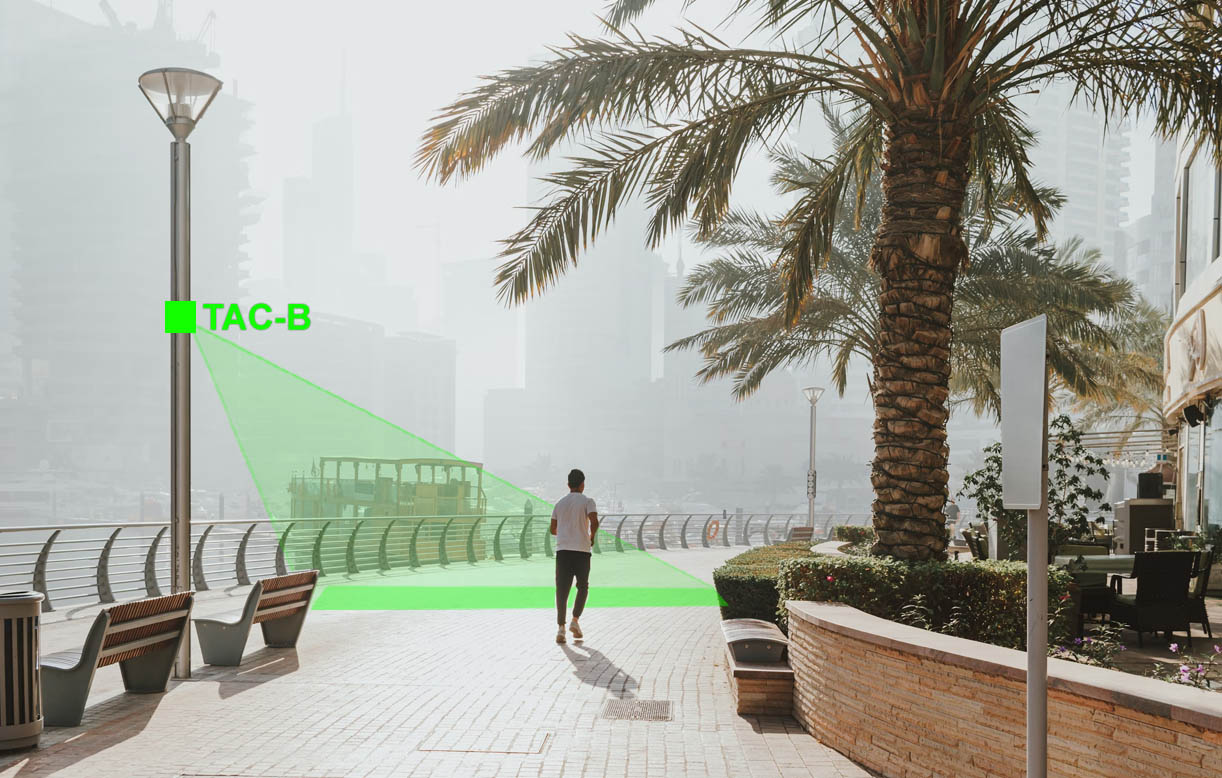
Mounted on a pole or wall at heights up to 6 m with a 0-45 degree downward tilt and no blind spot directly beneath the housing, TAC-B sensors deliver detailed spatial analytics across wide detection zones:
- Pedestrian and cyclist separation: When wall-mounted, the radar distinguishes walkers from cyclists and e-scooter riders so urban mobility teams can evaluate bike lane usage alongside footfall.
- Rich spatial metrics beyond IN/OUT lines: Alongside directional line crossings, the sensor reports 5-minute Total Flow statistics without requiring crossing lines, Engagement and Capture Rate near entrances or public exhibits, Hourly Heatmaps, and directional flow aligned to Mounting Azimuth (0-359 degrees across 8 compass directions).
- Open telemetry and reporting: Bidirectional SensMax MQTT v2.0 supports live telemetry and remote OTA firmware updates, while daily dashboards and charts are available through the included SensMax Prism app and online reporting portal.
Planning Power and Data Delivery Across Sites
Before ordering hardware, map how power and connectivity reach each counting point. Most outdoor networks use one of three deployment patterns:
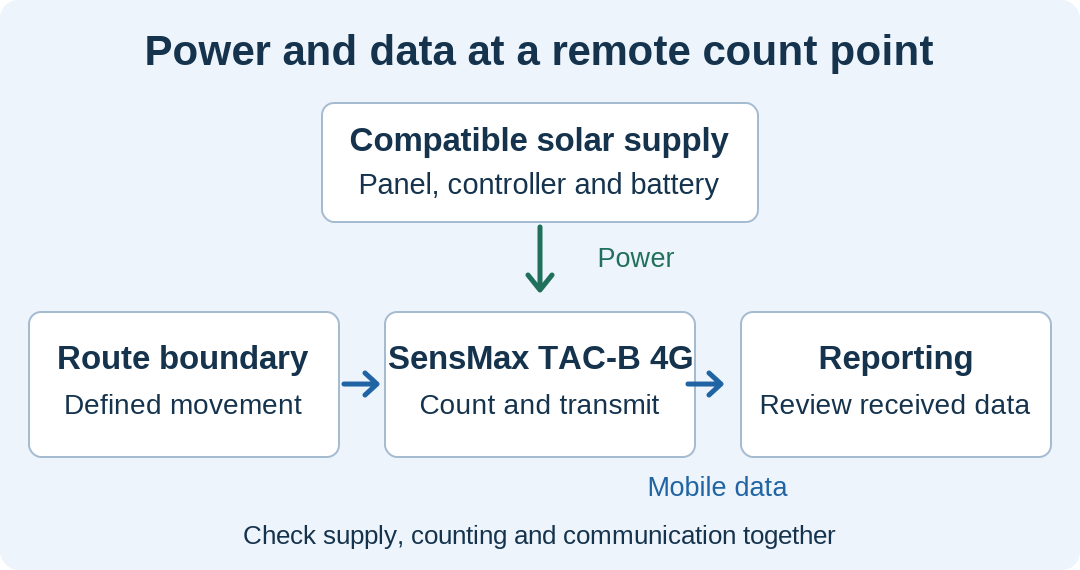
- Battery and manual collection (SensMax SE or DE): Best for remote hiking trails, forest entrances, and seasonal parks where rangers visit every few weeks or months.
- Solar power and 4G cellular (SensMax TAC-B 4G with SPS20 solar kit): Ideal for bus stops, park plazas, and greenways without grid lines where planners still need live 5-minute updates.
- Wired PoE (SensMax TAC-B EWP): Suits municipal facades, stadiums, campus walkways, and illuminated streets that already have Ethernet cabling.
Key Takeaways
- Choose battery-powered SensMax SE or DE infrared sensors for narrow trails, bridges, and park gates that lack electricity and internet.
- Deploy 60 GHz mmWave radar (SensMax TAC-B 4G or TAC-B EWP) for wide sidewalks, plazas, and shared paths where people walk in groups or ride bikes.
- Outdoor mmWave radar operates accurately in bright glare, shadows, rain, and darkness while remaining completely anonymous and GDPR-compliant.
- Match power and connectivity to reporting urgency: manual handheld collection for seasonal trends, or 4G, solar, and PoE for live telemetry.
Frequently Asked Questions
How can we count pedestrians in parks or trails without electricity?
Use battery-powered infrared beam counters such as SensMax SE or DE. They mount on posts, trees, or trail gates without power cables, store up to 250 days of hourly statistics internally, and run on batteries for up to 2 years.
Can outdoor pedestrian counters separate walkers from cyclists?
Yes. Wall-mounted SensMax TAC-B 60 GHz mmWave radar sensors distinguish pedestrians from cyclists and e-scooter riders by movement characteristics, giving municipal planners separate counts for each group across shared paths.
Do outdoor radar counters work in rain, fog, and direct sunlight?
Yes. Unlike camera-based systems that struggle with harsh shadows, glare, or darkness, 60 GHz mmWave radar detects movement reliably in rain, fog, night lighting, and shifting sunlight without recording images.
Are SensMax outdoor pedestrian counters GDPR-compliant?
Yes. Neither infrared beam counters nor mmWave radar sensors capture video, photos, or personal device identifiers. Only anonymous movement counts, flow totals, and spatial statistics are processed and stored.
Planning an outdoor counting project across trails, parks, or city streets? Share your path widths, power availability, and reporting goals in the inquiry form below, and our team will recommend the right SensMax SE, DE, or TAC-B configuration for your sites.
Ask your question
Tell us briefly about your project - our engineers will recommend the optimal configuration and send a quote.