Temperature & Humidity Monitoring for Data Centers


Remote Temperature and Humidity Monitoring for Data Centers and Server Rooms
Modern data centers and server rooms contain high-value IT equipment that is sensitive to temperature and humidity. The SensMax SensGuard remote temperature and humidity monitoring system helps prevent overheating, condensation and static-related failures by continuously monitoring conditions around racks, cabinets and network rooms and sending instant alerts if values leave the safe range.
What the data center environmental monitoring system does
SensGuard provides continuous data center temperature monitoring and server room humidity monitoring at multiple points across the facility. Wireless sensors measure ambient conditions near racks, in hot and cold aisles, in UPS rooms and in network closets. Readings are sent to the cloud every 5 minutes and compared with predefined thresholds for each zone.
If cooling fails, airflow is blocked or humidity drifts into a dangerous range, the system notifies responsible staff immediately. This reduces downtime risk, protects equipment investments and supports SLA stability for hosted services.
Why temperature and humidity monitoring matters in IT rooms
Server rooms require stable airflow and controlled humidity 24/7. Problems often start locally: a failed fan unit, blocked intake, incorrectly tuned setpoints, open cabinet doors or an overloaded rack. Remote monitoring helps detect abnormal zones early and act before equipment overheats or condensation becomes a risk.
- Early warning of cooling failures and local overheating near racks
- Humidity control to reduce condensation risk and static discharge risk
- Trend history for root-cause analysis and recurring issue detection
- Remote monitoring for branch IT closets without on-site staff
- Audit-ready reports to document environmental stability over time
Use cases for data centers and server rooms
- Data centers — monitoring hot and cold aisles, server racks and equipment rooms
- Corporate server rooms — maintaining stable conditions for critical business systems
- Network and telecom rooms — monitoring switches, routers and communication equipment
- UPS and battery rooms — tracking temperature near batteries and power systems
- Small IT closets in branch offices — simple remote monitoring without on-site staff
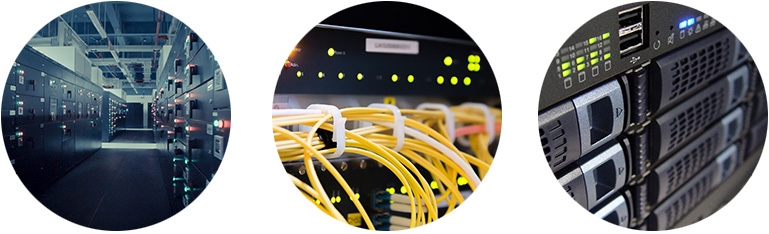
Typical sensor installation points: hot/cold aisles, racks, UPS rooms and network closets.
How the SensGuard system works
Cooling systems, air distribution and humidity control in IT rooms must be monitored continuously. SensGuard uses wireless temperature and humidity sensors installed at critical locations to measure conditions every 5 minutes. For each sensor you can configure individual min/max thresholds and an allowed violation time to avoid alarms from short fluctuations.
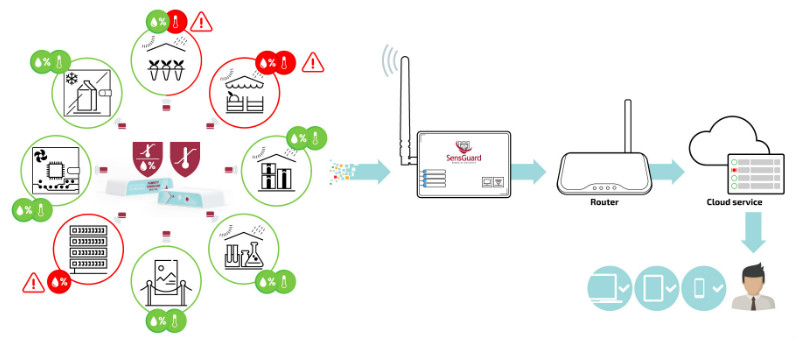
SensGuard monitoring architecture for server rooms and data centers.
The SensGuard solution consists of three main components:
- Wireless temperature and humidity sensors that monitor racks, aisles and technical rooms
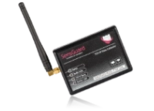
- SensMax TCP LR X2 gateway that collects sensor readings and transmits them to the SensGuard cloud
- SensGuard cloud software that displays zones, alarms and historical trends in a web browser
Sensors operate on an internal nonflammable battery for up to 5 years. One gateway can handle up to 250 wireless sensors within 150 m (extendable using repeaters) and includes buffer memory to prevent data loss during temporary Internet outages.
Request server room monitoring consultation
Hardware used in this solution
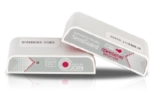
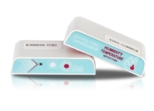
Different areas in a data center may require different sensor types. SensMax provides wireless temperature and humidity sensors and probe-based devices suitable for racks, technical rooms and equipment cabinets.
| Device | Type | Temperature range | Accuracy | Resolution | Battery / Power | Typical use |
|---|---|---|---|---|---|---|
| MCP9800 wireless temperature sensor | Waterproof sensor | −20°C…+55°C | ±0.5°C | 0.1°C | up to 5 years | Ambient server room temperature monitoring in hot and cold aisles and general rack areas. |
| ENS210 wireless temperature & humidity sensor | Temperature & humidity sensor | −20°C…+55°C / 0–100% RH | ±0.5°C / ±3.5% RH | 0.1°C | up to 5 years | Humidity monitoring in mixed airflow zones, network rooms and areas where condensation risk must be controlled. |
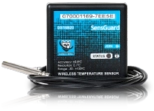
| DS18B20 probe-type wireless temperature sensor | Probe sensor | −30°C…+120°C | ±0.5°C | 0.1°C | up to 5 years | Cabinet and equipment monitoring where the probe is placed inside a closed rack or near specific power devices. |
Reporting and alarm management
SensGuard records all temperature and humidity values, alarm events and user actions, creating a complete history per zone. This supports trend analysis, early detection of cooling problems and documentation that conditions stayed within agreed limits.
Charts and logs can be exported as CSV or PDF reports for internal reviews, customer reports or SLA documentation.
Recommended configuration for a typical data center or server room
- 5–40 wireless sensors depending on the number of racks, rooms and technical areas
- 1–2 SensMax TCP LR X2 gateways with LAN/Internet connection
- SensGuard cloud accounts for IT operations, facility management and on-duty staff
- Automatic alarm notifications via e-mail and Telegram messenger when thresholds are exceeded
SensGuard cloud software for server rooms and data centers
The SensGuard online portal provides a clear overview of environmental conditions in all zones. Users can:
- see real-time temperature and humidity values per rack area, room or cabinet
- upload a data center map and place sensors on it to identify problem locations faster
- set separate thresholds and allowed violation times for different zones
- route alarms to specific teams responsible for particular rooms, racks or sites
- review alarm history and operator comments for root-cause analysis
- download temperature and humidity reports for any selected period
FAQ — Server room temperature and humidity monitoring
- How often are temperature and humidity values recorded?
Sensors measure and transmit readings every 5 minutes through the gateway. - Can I set different thresholds for different zones?
Yes. Each sensor has individual min/max thresholds and an allowed violation time. - What happens if the Internet goes down?
The gateway includes buffer memory to prevent data loss during temporary outages. - Is the system suitable for remote IT closets?
Yes. Wireless sensors and remote alerts support monitoring of small branch server rooms without on-site staff. - Can I monitor inside closed racks?
Yes. Probe-type sensors can be used to measure temperature inside cabinets or near specific equipment. - How are alerts delivered?
Alerts can be sent via e-mail and Telegram messenger when thresholds are exceeded for longer than the allowed time.
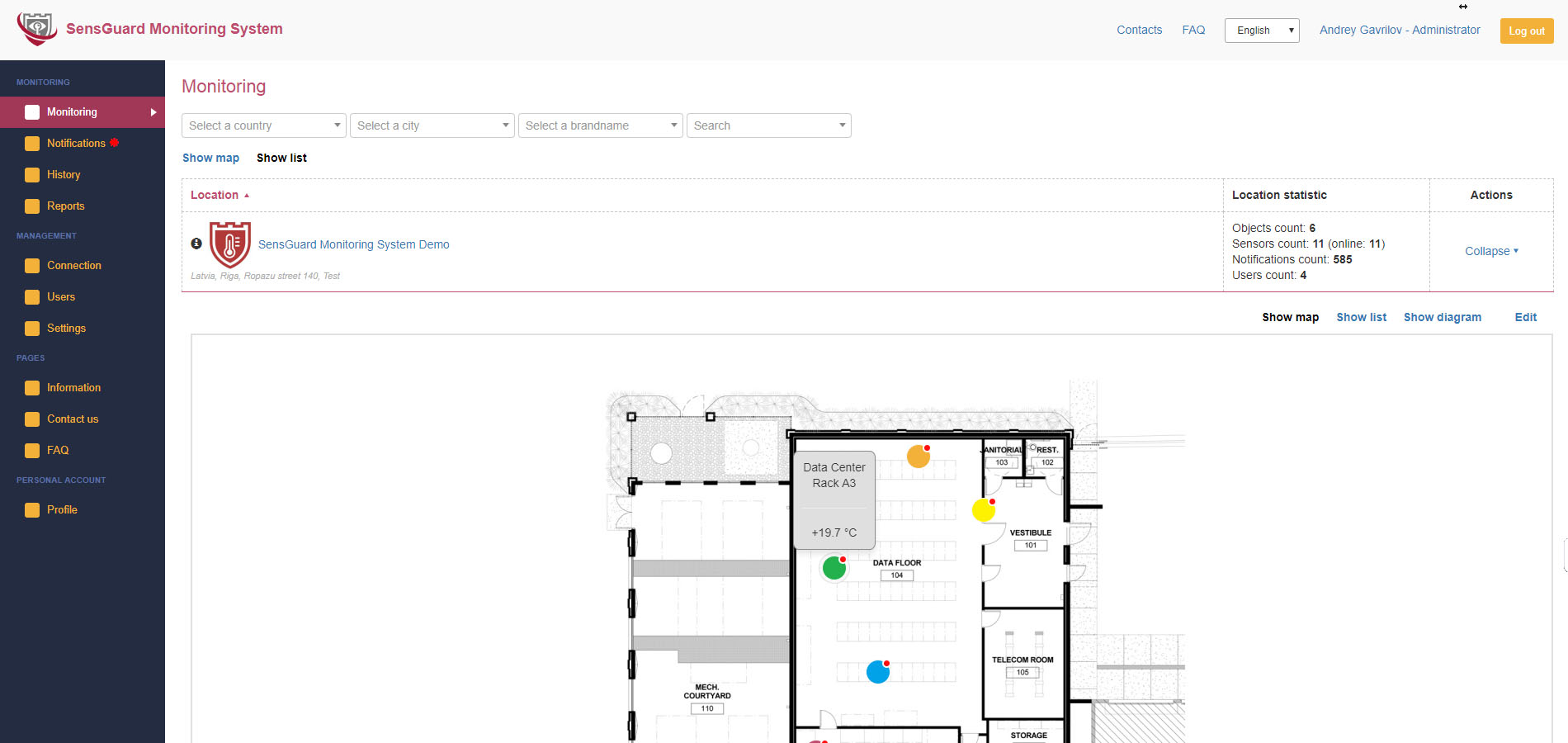
Overview of monitored server rooms and technical areas with current readings.
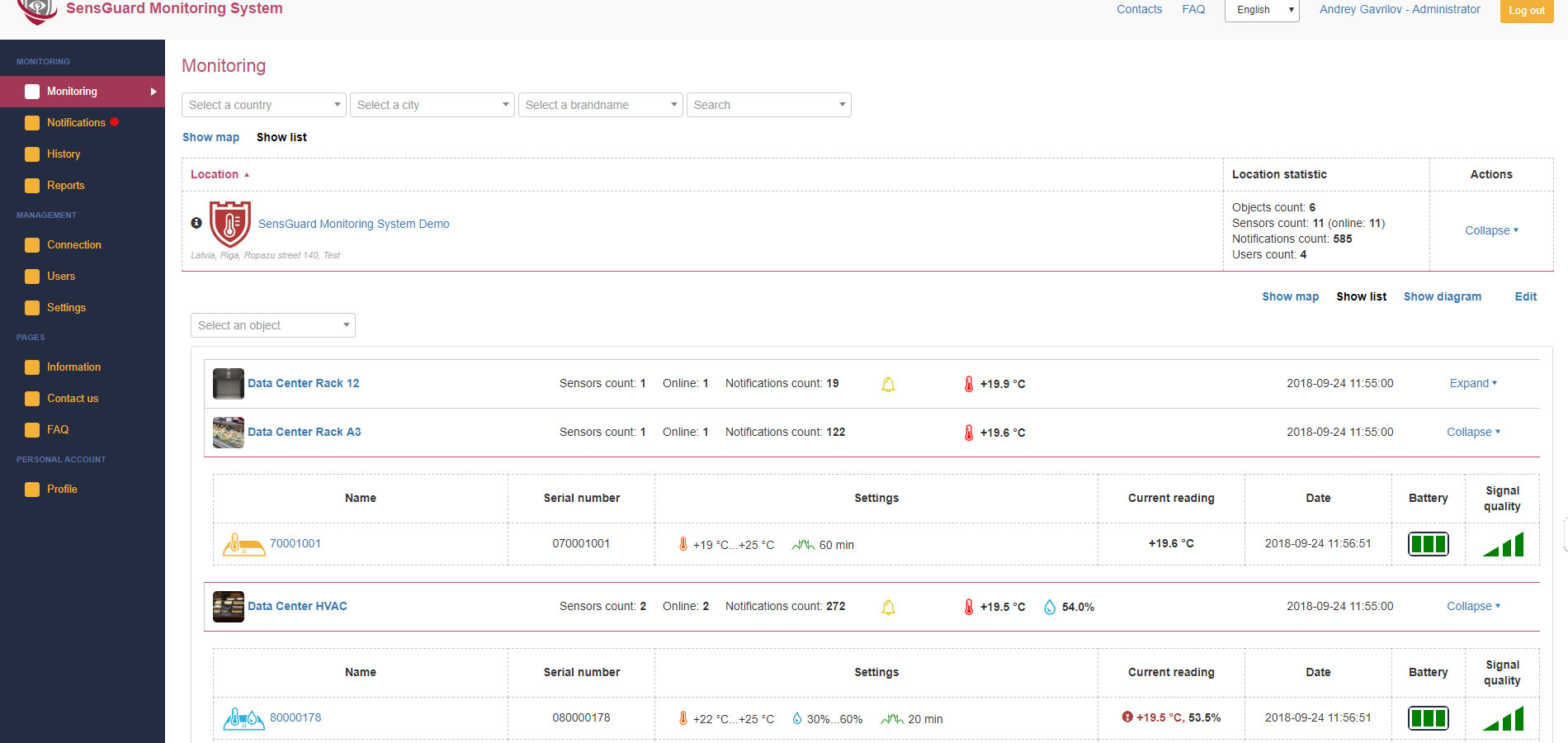
List of sensors near racks, UPS rooms and network closets with live status indicators.
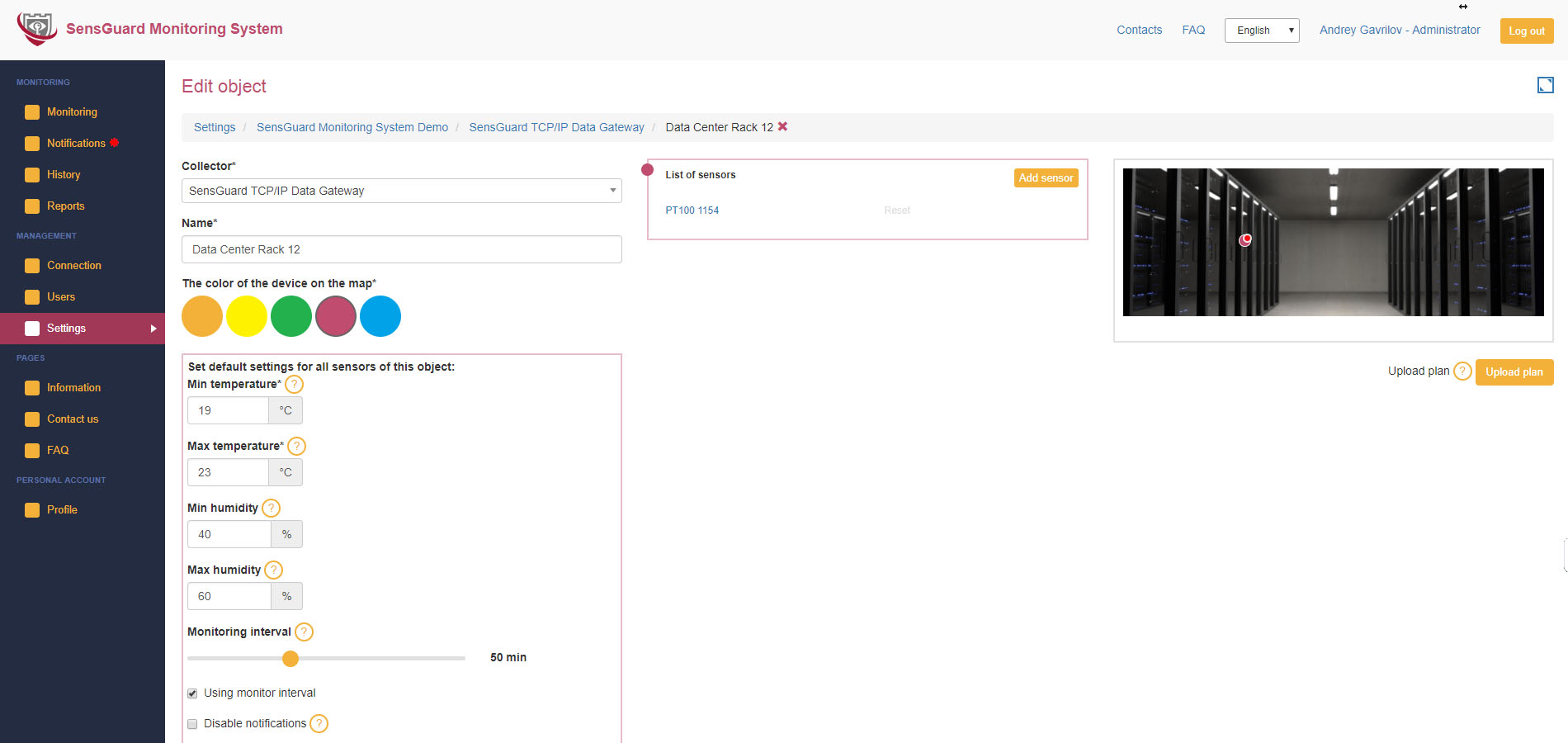
Sensor detail page with threshold settings and alarm history.
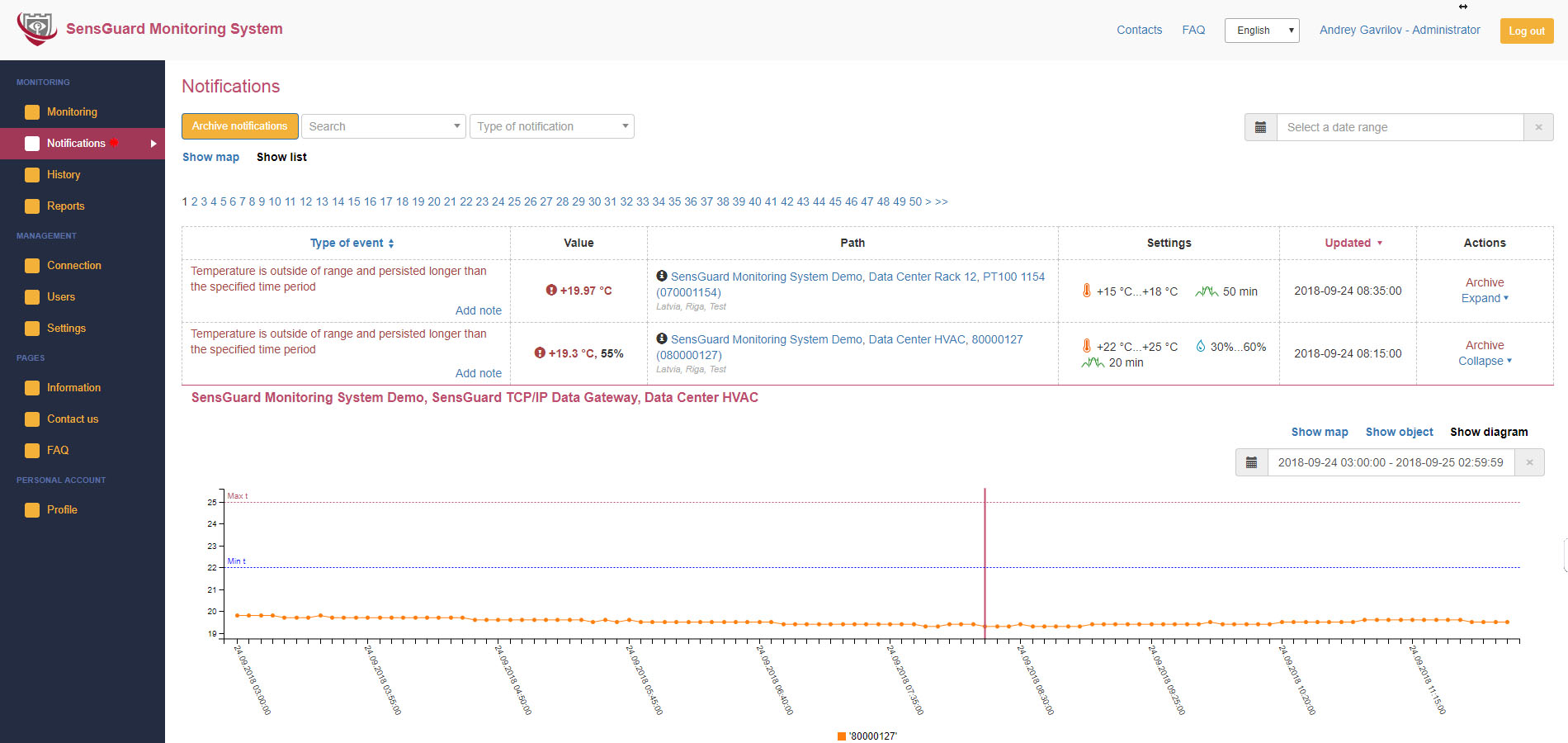
Trend chart showing temperature and humidity behavior over time, including alarm periods.
Request a quote for data center monitoring