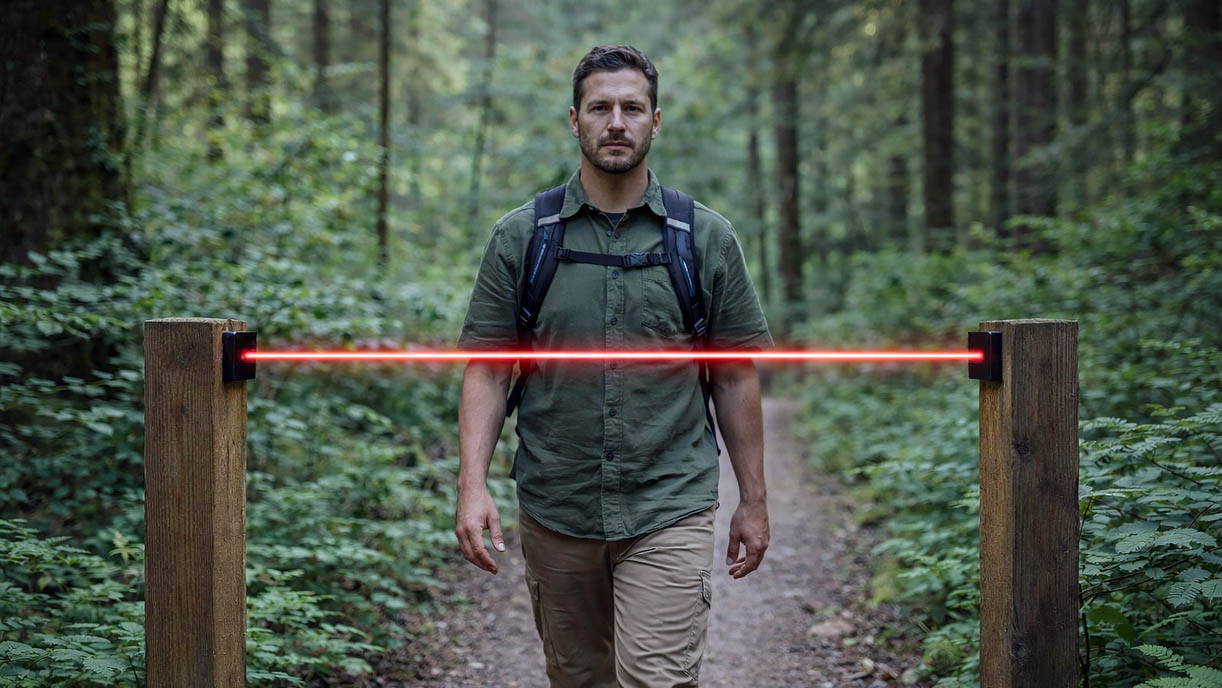
Understanding visitor behavior is crucial for the effective management and preservation of protected natural spaces. For public administrators, tourism offices, and environmental agencies, accurate national park footfall data informs everything from maintenance schedules and conservation efforts to funding applications. However, the very nature of these remote locations—often lacking reliable grid power and internet connectivity—presents a significant challenge to traditional monitoring methods.
Fortunately, specialized, autonomous people counting systems provide a reliable solution for collecting visitor statistics even in the most isolated areas. By leveraging self-sufficient power sources and offline data storage, these devices make outdoor visitor counting accessible for any park or trail.
The Importance of Off-Grid Footfall Data
Understanding footfall patterns helps park administrators, conservation bodies, and tourism managers make better decisions. Visitor counts can inform:
Collecting visitor data in remote settings is vital for several key management objectives:
Resource Allocation: Data on visitor volume and seasonal trends allows managers to plan trail maintenance, deploy staff effectively, and manage amenities like restrooms, waste management planning and parking based on actual usage.
Funding Justification: Accurate footfall metrics provide concrete evidence of a park’s utilization and success, which is often mandatory for reporting to tourism programs and securing future funding.
Safety and Crowding Management: By monitoring visitor flows, managers can identify areas prone to crowding, optimize emergency planning, and protect sensitive ecosystems from overuse.
Conservation Planning: Visitor numbers directly affect ecosystems. A trail that sees thousands of hikers each month will erode faster, disturb wildlife, and require more frequent restoration. By tracking footfall, park managers can identify overused areas and redirect traffic to less sensitive zones, preserving biodiversity.
To meet the specific requirements of remote outdoor installations, SensMax offers fully autonomous people counting solutions that operate entirely off-grid. These systems can be categorized into standalone infrared beam counters and real-time solar-powered radar units.
Standalone Counting for Trails and Gates (SensMax SE & DE)
For straightforward, battery-operated counting along trails or at specific access points, infrared beam systems offer flexibility and exceptional battery life. These units are housed in robust, weatherproof casings suitable for outdoor installation on poles, trees, or walls.
1. SensMax SE: The Entry-Level Total Counter
The SensMax SE is a simple, entry-level people counter that utilizes an infrared beam to detect movement.
Counting Method: Unidirectional. It counts the total number of passes across the beam, making it ideal for estimating total national park footfall along a path.
Power & Battery Life: Runs on standard batteries, offering an extremely long operational period of up to two years before replacement is needed.
Best Use: Monitoring narrow footpaths, bike trails, and simple single-access entrances where directional information (IN/OUT) is not required.
Data Retrieval: Data is stored locally in the sensor's memory for months and is collected manually using a handheld data reader.
2. SensMax DE: Bidirectional Monitoring for Entrances
The SensMax DE builds on the SE by incorporating sophisticated direction detection, providing deeper analytical insight.
Counting Method: Bidirectional. It accurately separates traffic into IN and OUT counts, making it perfect for tracking park occupancy or visitor flow through specific gates.
Power & Battery Life: Operates on standard AA batteries, providing reliable performance for up to 12 months.
Best Use: Park entrances, visitor center access points, or complex loop trails where distinguishing between incoming and outgoing visitors is critical.
Data Retrieval: Similar to the SE model, data is stored internally and retrieved manually using a handheld SensMax SE/DE data collector via a short-range infrared link.
Installation: It is a wireless, plug-and-play solution, making installation quick and simple with no special cabling work required
Real-Time Monitoring for Remote Hubs (SensMax TAC-B 4G)
The SensMax TAC-B 4G is an outdoor, real-time people-counting radar specifically designed for remote hubs where traditional internet (Wi-Fi/LAN) or electricity may be unavailable. For park management teams requiring continuous, real-time data from remote locations, SensMax provides a cutting-edge, self-powered radar solution.
Core Capabilities for Remote Monitoring
Built-in Connectivity: Features an integrated 4G/LTE modem, allowing it to stream live data directly to the SensMax Cloud platform without needing a local hub or router.
Off-Grid Power Options: Can be paired with the SPS20 Solar Power System, which includes a LiFePO4 battery providing up to 85 hours of backup power during low-sunlight periods.
Radar Precision: Detects and distinguishes between pedestrians and cyclists/scooters based on speed and movement patterns. It tracks bidirectional (IN/OUT) traffic across up to five user-defined virtual counting lines.
Privacy Compliance: Unlike camera-based systems, it is 100% GDPR-compliant as it collects only anonymous movement data without capturing faces or personal identifiers.
SensMax TAC-B 4G + SPS20 Solar Panel
This is a high-performance, off-grid solution for real-time people and bicycle counting. This combination is specifically designed for remote areas like national parks, trails, and smart city streets where electricity and fixed internet are unavailable.
This system combines a high-accuracy 3D radar counter with a dedicated solar power station (SPS20) to ensure continuous, grid-independent operation and connectivity.
Counting Method: 3D Radar Sensor. The sensor provides high accuracy over a wide area, covering up to 100 m². Approximately 99% for pedestrian traffic (~1 person/m²) and remains above 93% even in crowded environments.
Power Source: The SPS20 solar panel kit with battery backup ensures the system runs indefinitely without needing connection to grid power.The integrated 256Wh LiFePO4 battery provides 64–85 hours of operation without any sunlight, ensuring continuous counting through nights and overcast periods.
Connectivity: Features a built-in 4G modem for autonomous, real-time data transmission directly to a cloud-based reporting dashboard.
Best Use: Large park entrances, visitor assembly areas, or remote sites where real-time operational data and remote system diagnostics are required.
By offering a range of fully autonomous devices—from the simple, long-life SensMax SE for trails to the high-tech, real-time SensMax TAC-B 4G radar—national park footfall tracking is no longer reliant on existing power or internet infrastructure. These self-sufficient systems empower park managers with the reliable, actionable data needed to protect, fund, and optimize the visitor experience in our most treasured natural environments.